PAD Challenge – Day 7

A week into the challenge, and I’m still hanging on. Some days the right  words (or at least the right ones for the moment…) have come easier than others.  Whether they enter the world racing like a hare or plodding like a tortoise, at least there’s something new for me to play with and polish.

Today’s prompt from Poetic Asides was to write an Urban _____ poem. I wouldn’t normally choose a title like this, but I’m sticking to the rules for this one.

Urban Night


2 a.m. —

the last bus

shrieks at the drunk girls.


On 93rd

a woman’s staccato steps

stutter over broken glass.


Quiet alley

two rats make peace

for the pizza crust


Something is always

awake and tossing,

insomniac city.


Over at This Is Not A Literary Journal, the prompt asks poets to go outside, observe and write. I think this is always a great way to get ideas stirring, and I hope I can find a few minutes to do it today.

The NaPoWriMo site suggested trying a Tritina. I wasn’t familiar with this form, which reads like a sestina, only in threes. But after reading a few samples online, including the beautiful example piece by David Yezzi, I am now a fan. I find following a form to be extra challenging, but also rewarding when it works. Bookmarking this to try later. Maybe I can use all those lovely outdoor observations for inspiration.
 

PAD Challenge – Day 6

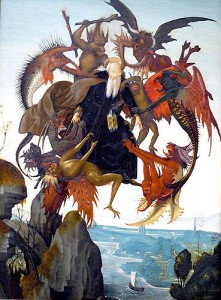
I heart ekphrastic prompts, so I was pleased to see the Poetic Asides prompt today was to write  a poem inspired by one of three images, or one of your own choosing. I picked Michelangelo’s First Painting (The Torment of Saint Anthony). Apparently he painted this when he was 12, which is pretty darn cool. It was also his own interpretation of a similar engraving by artist Martin Schongauer, so kind of ekphrastic in its own right. Lots of amazing imagery in here, but it was something about a boy painting a “good guy” battling all those fierce “bad guys” that got me thinking this way:

Superhero Sketch


Picture Michelangelo at 12, on the cusp of manhood,

bored with school and daydreaming in doodles.

Sketching superheroes in beards and robes,

not steel-jawed or muscle bound,

but mighty all the same.

Ordinary men doing extraordinary things.

And he, learning the world like we all do.

Drawing the lines between right and wrong.

Struggling to stand tall,

even with all those demons on his back.


michelangelo_first_painting-221x300

The NaPoWriMo prompt is also one of my favourites…poetry about food! I’ve written a few of my own in the past, but none as wonderful as “Peas & Barbies” by Catherine Graham, presented here by poet Lisa de Nikolits.

PAD Challenge – Day 5

I was able to weave two prompts together today: the Poetic Asides two-for-Tuesday assignment to write about experience/inexperience, and the NaPoWriMo prompt to find inspiration in the names of heirloom vegetables. I had tomatoes on the brain, as well as memories of my Mom.

Tomato Aspirations


I dream of a garden of nightshade delights, edible wonders, plump and luscious

painting a triptych of wooden garden boxes every hue of red, orange and yellow.

I dream of my Mom’s tomato plants, wending through the white boards

of our backyard fence, or pressed into their metal cages, like buxom women

chastened by corsets.  In August, they’d lean and bow, ready for the curtain to fall,

ready for rebirth in her crock pot and jars, in salsa and sauce, relish and paste.


I turn to the catalogue for advice. The names alone sow seeds of imagination:

the stately Principe Borghese, at its best basking and baking in the sun.

The mighty Neptune and Martian Giant —tomatoes bold enough to grow

where no tomato’s grown before. There’s the extravagant Marglobe VF,

with a moniker like a sports car and  priced six times higher than every other plant.

Picture it staked  on a plot all its own, Esq. etched at the end of its custom gold nameplate.


But who am I kidding? I’m a greenhorn, not a green thumb. I live on the Prairies.

I need hardy, pragmatic plants, not opulent show-offs. I need the Glacier tomato, cold

weather ready with its thick skin and ruddy face. I need the no-nonsense  Large Red Tomato,

frank but fruitful. Straight shooter of the soil . Give me produce, not pretense, baby.

Give me enough sun, rain and patience to see me through the season.

Give me just one juicy globe, that I can hold up high, as I brag to the sky,

Mom! Look what I made!


I did like the prompt suggested by the folks at This Is Not A Literary Journal to harvest words from the signs you see, and will certainly try that another day. The mention of the word “signs” reminded me of the superb There Were No Signs by Irving Layton, which you can listen to here.

PAD Challenge – Day 4

I love odes. I suppose most poets or poetry lovers do, but I confess I have never been very good at writing them. An ode to something indulgent is the prompt over at This Is Not A Poetry Journal today, and though I wish I could indulge, the ode-thoughts just aren’t coming at the moment. I was reminded of poet Elizabeth Zetlin’s ode to that loved and hated mark of punctuation: the apostrophe.

The NaPoWriMo prompt gives a nod to the famous Eliot line about April being the cruelest month, but I already covered my thoughts on that a few days ago. However, I do have a month that I view as the cruelest: February. Last year, at the start of March I wrote a rally against February, and a praise of March (almost an ode?), which you can read here, if you’re so inclined.

Finally, the Poetic Asides prompt to write about “distance” had me thinking micro-sized again, so here are my small words for a large space:


wishing on stars

distant train whistle

brings us down  to earth


PAD Challenge – Day 3


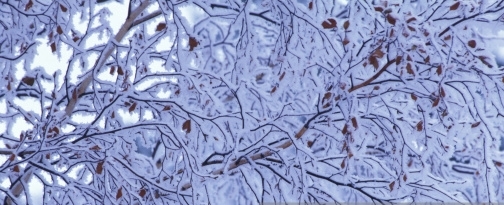
poplar hoar frost

I’ve got a prompt meld going on today between the Poetic Asides suggestion to write a Three _____ poem, and the This Is Not A Literary Journal challenge to “write what the trees know,”  Here’s what grew:

Three Things Our Poplar Tree Knows


That when hoar frost swaddles

its bald branches, the day will be

defined by silence. Words we’ve used

so often to sting, turn soft and

crystalline on our tongues.


That the damp cloak of decayed leaves

still draped on the grass at the start of

spring, will smell both fetid and fresh.

The contrast and symmetry that used

to define us.


That its softening middle, the spongy

bend of boughs once strong and rigid,

are not reasons to mourn. Heart rot,

a harsh name for the feeling inside:

change. Touch the caramel-coloured

conks embellishing its trunk.

Listen when it tells us

the great  beauty of loss

is clarity.


The tree prompt made me think of Trees by Bliss Carman. I, too, am in praise of “goodly trees in the springing sod.”

Lastly, the NaPoWriMo site suggests a fan letter poem to a celebrity. I’ve composed many gushing letters in my brain to Trent Reznor, but never attempted to put them to paper. Perhaps a project for this afternoon….whilst listening to NIN, of course.


Poem-a-day (PAD) Challenge – Day 2

I’ve got three prompts going for the second day of NaPoWriMo, and all it’s amounted to so far is one micro-poem, but there are other ideas whirring around.

The prompt over at the Poetic Asides blog was to write a “he or she said” poem. There’s a an active community of talented and encouraging poets who frequent this blog, so it always a good destination — especially mid-April when the energy and inspiration reserves maybe getting low.  For this I did complete a micro-something that may grow into something more:

Clear

He said there was

a storm in his head

as long as he

could remember, but

the first time

he kissed her

the sky cleared

and stayed that way

as long as she

was his.


I’m hoping something interesting will come of the This Is Not A Literary Journal Prompt to “write the lie you used to believe.” Perhaps something fun, or witty.

Today, April 2, also would’ve been my Mom’s 73rd birthday, so the NaPoWriMo.net prompt to write a “family portrait” poem is quite fitting. Before my Mom’s death, and certainly since, I’ve written much about family and her specifically. I don’t know if this is a well that will ever run dry, and for that I’m grateful.

Lastly, I’d like to invite any willing readers to check out this link to one of my favourite poems by one of my favourite poets: Lorna Crozier’s Fear of Snakes. I love everything about this poem, but each time I read it, it’s the opening line that gets me. The imagery and rhythm are just stunning.

April is the poemiest month!

Hooray! It’s April, and the start of National Poetry Month! I love April for many reasons, like more hours of sunshine, the promising sight of tulips pushing out of the brown earth, and the fabulous Edmonton Poetry Festival. While I adore T.S. Eliot **, I just can’t agree that April is the cruelest month…not when so many poets come together to celebrate words.

Last year I approached the April poem-a-day challenge with gusto, and managed to squeak something out every morning. Some of those poems will always remain the unseen wordblurt of a first draft, but several have become poems I’ve felt confident enough to share at readings, or to include in my manuscript-in-progress. What I really took away from last year was a kind of discipline to write every day, and the realization that there are no wasted words. I also learned so much by reading the work of other poets.

This year I’m trying to use the prompts at both the Poetic Asides poem a day challenge, and the NaPoWriMo prompts posted at This Is Not A Literary Journal.  I’m not sure I’ll manage to write two poems every day, but I’ll see where the ideas from each site take me.

Some days I will post my own poems here, and some days I will post a link to beloved poems by others. Whenever possible, I will try to post links to works by Canadian poets.

So hooray for April, the wordiest month!

Oh, and here’s the quick bit I wrote for today’s Poetic Asides prompt to write a “fool” poem:

daffodils

sheathed in snow

April Fool

** And do click here to read the beautiful poem The Waste Land by T.S. Eliot

Re-visioning Revision

There’s a quote by Raymond Chandler that I remember reading: “Throw up into your typewriter every morning. Clean up every noon.” I love this quote, not just for the nostalgia invoked by the word “typewriter,” but because it succinctly captures the importance of the two things I find most difficult about writing — not editing myself before I get the words down, and then really editing myself once they’re on the page.

Until recently, I’ve viewed revision as a loathsome process. When I’ve stopped doubting myself enough to actually get a poem or prose piece finished, it’s still far from polished. The scrubbing, shining, rearranging business that’s necessary in order for something to go from done to good is the hardest part, especially when mine are often the only set of eyes examining the writing. On any given day I can go from thinking a particular line is the best thing I’ve written, to wondering why I even bother with all the ridiculous word goop I’ve blarbed onto the page. My inner voice is a mess of contradiction, but I console myself with the knowledge that this is the case with pretty much every writer.

The struggle comes in trying to shut my mind-yabbering up long enough to actually get the revisions done. When it comes to my poems, it helps if I can put them away for awhile —weeks, sometimes even months— before trying to fix them. After a break, I can sometimes see more clearly what I’m trying to say, and ways to say it better. But this isn’t always the case, and when it doesn’t come easily, my instinct is to just ignore the poem, like a cavity. I know it won’t heal itself, but I think if I just forget about it, it won’t cause too much trouble.

Of course it will cause trouble, eventually. All those cavities will just get me a mouth full of holes, not something I want to show off or be proud of. I owe it to myself, and my poems, to do the work necessary to make them better. This is the best of many lessons I’ve learned so far as part of my apprenticeship with the Writers’ Guild of Alberta Mentorship Program. My wonderful mentor, Sue Sinclair, has shown me see that the re-writing can actually be the most rewarding part. It’s easier, now, with her experienced voice telling me “this is what’s not working and this is how to fix it.” But I’m learning to see it for myself too. I’m learning to re-vision revision. I’m approaching it with a more open mind, less fear and discouragement, and the knowledge that the hard work of editing, while still not enjoyable, is the path that leads to real rewards. I can’t just throw up all those words and leave them. If I want people to come over — and I do — it’s time to make this mess into something pretty.

Poem: Dubbing Planet 9

Most days, reading or watching the news makes my heart ache.  This week, hearing about the quiet planet chillin’ at the edge of our solar system, took me to a different kind of dark place — the beautiful mystery of space.


Dubbing Planet 9


We can’t see you, shadow planet,

but we know you’re there.

This is more than faith.

More than wishes made

on all the shining stars.

(Maybe it’s your light, so bright,

that we’ll see tonight —

forgive us our mistake).


You can’t hide forever,

even floating far

past imagination.


We’ve got your tracks, elusive giant.

You Bigfoot in space,

and we’re excited, tittering,

because we love to dub.


This is our time, baby.

Our chance to claim the cosmos.

No more stuffy Roman gods,

no more démodé Greek deities.


You need a now name.

Something trending:

#PlanetSoFar

Uber

Drake


Make you mononymous, female:

Marilyn

Oprah

Adele


Or formal, with title,

honorifics for our stellar stone:

King Orb

Lady Rondure

Miss Mary Mack Mack Mack

(Way out in black, black, black).


A century from now,

if you’re spotted, snapped, shown

to all the world, will we know better

how to name?


Is something ineffable until it’s seen?


What new words will have sprung from

our multilingual human tongue?


A millennium from now, if humanity remains,

curious, searching, able

to touch your primordial face,

will we know you then?


Will we be any closer to understanding

why you’re there, why we’re here,

why anything is

at all?